
From Youth Activist to Climate Leader:
Aya Zrigat's Journey
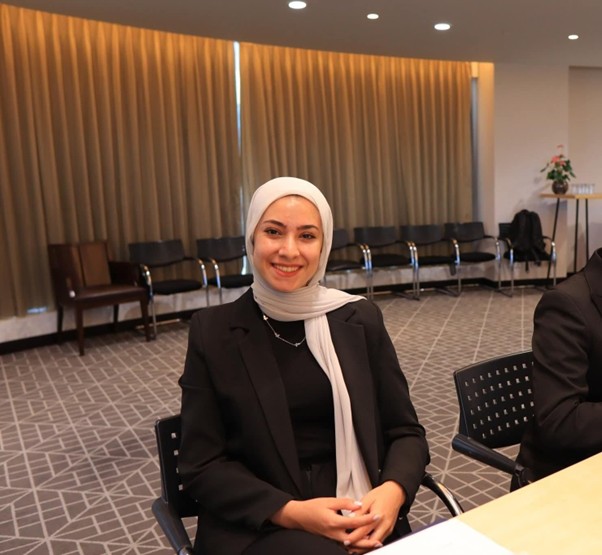
At 22, Jerash-born youth activist and engineer Aya Zrigat already wore many hats—trainer with Jordan’s Ministry of Youth on UNSCR 2250, researcher with UNICEF on participatory action, and coordinator of “Policy on Mic,” supported by the King Abdullah II Fund. In 2025, she chose EcoPeace’s Climate Diplomacy program to deepen her understanding of Jordan’s climate reality and to build practical skills she could use across her work.
EcoPeace delivered on both. Through a multi-phase training, Aya moved from general interest to data-grounded awareness—learning the basics of Jordan’s water crisis, the Jordan River’s condition, and per-capita water indicators. Equally transformative were the skills: structured negotiation, clear public speaking, and concise elevator pitching. “Information that sticks changes behavior,” she notes—skills and content reinforced one another.
Aya put those gains to work immediately. With teammates, she co-created AKAN, a digital platform concept that connects environmental NGOs with the Ministry of Higher Education to channel university students into climate trainings and opportunities that count as volunteer hours. AKAN clarifies who does what (water, food security, etc.), reduces duplication, and builds a pipeline of qualified youth—complete with a future ambassador track for regional and global forums. After presenting the idea in Cyprus, the team partnered with Ahel to turn AKAN into a student-led campaign, intentionally building bottom-up demand before approaching the Ministry—an organizing strategy Aya credits to her EcoPeace training.
Her advocacy widened beyond one project. With Generations For Peace and UNICEF’s regional office, Aya now campaigns on threatened native plants in Jerash and recurrent forest fires in Jerash/Ajloun—applying negotiation and messaging tools to coalition-building, funder outreach, and media engagements. EcoPeace’s network also expanded her reach across governorates; when she needs collaborators in Salt, Ajloun, or the Jordan Valley, she now has them.
Perhaps Aya’s most profound shift was on regional cooperation. She entered the program unwilling to engage with Israeli counterparts. Confronted with Jordan’s accelerating water scarcity and the cross-border nature of climate risks, her stance evolved toward pragmatic collaboration—pursuing solutions without conflating them with political recognition. “We may disagree on politics, but the environment demands action now,” she reflects.
Aya now introduces herself not only as a youth activist, but as a climate leader. She credits EcoPeace with sharpening her voice, structuring her outreach, and giving her a strategic lens: frame the issue with evidence, negotiate for win-wins, and organize communities to sustain the change. She actively recommends the program to peers—especially skeptics—urging them to “see it firsthand before judging.”
Aya’s journey shows how targeted training can turn passion into organized impact. By pairing advocacy experience with environmental diplomacy, she is building youth pathways (AKAN), advancing protection for ecosystems at risk, and modeling the cross-sector, cross-border cooperation that Jordan’s climate future requires.